">
Warmest Canadian winter on record

Tuesday, March 14, 2006

The winter of 2005/2006 has been the warmest winter in Canada since the beginning of the nationwide weather record in 1948, with average nationwide temperatures 3.9°C above the long-term average. Statistically, such a strong deviation from the average is expected to be observed only once in 100 years.

While most of the country was experiencing temperatures of at least 2°C above normal, in most of Alberta, Saskatchewan and the Northwest Territories the temperatures were 6°C above normal, with some regions averaging up to 8°C above normal.

For this statistic the months from December through February were counted as winter.

Lack of ice in eastern Canada will probably affect the annual harp seal hunt, which typically starts around March 15. In February, so little ice had formed that Environment Canada reported that such poor ice conditions had never been seen before in recorded history. The last time conditions approached what we saw in February 2006 was in 1969. The year 1981 was the third lowest ice year in recorded history.

In 1981, a number of harp seal mothers, who normally whelp only on ice, went to the shores of Prince Edward Island and Nova Scotia and gave birth on land. That year, due to the lack of ice, hundreds of thousands of seal pups drowned. The seals who were born on land faced both natural dangers such as death by exposure, and the danger of death at the hands of thousands of sealers, both licensed and unlicensed. These sealers took this rare “opportunity” to walk right up to a baby seal and kill it. Some of these seals were also attacked by domestic dogs.

Retrieved from “https://en.wikinews.org/w/index.php?title=Warmest_Canadian_winter_on_record&oldid=2611598”
">
“Woofstock” dog festival in Toronto, Ontario, Canada

Tuesday, June 12, 2007

North America’s largest outdoor dog festival came back to Toronto last weekend for its fifth year. It ran from the 9th of June to the 10th of June at Toronto’s historical St. Lawrence Market. A Wikinews reporter was there on Sunday to report on some of the events that happened on the last day.

The “Woofstock” dog festival attracted as many as 140,000 people with their dogs. The festival had tons of accessories, sold under tents, to buy for dogs; food, toys, designer clothes, and more. About 400 vendors and exhibitors were there to promote their products, which also gave private dog companies or groups a chance to show their new products. The local SPCA and some animal rescues were under tents answering questions from visitors. While walking, all visitors could see the CN Tower and other very tall buildings.

One of the local TV stations, Citytv, was there. They hosted a live event at the show which was broadcast on TV. People came up on the stage and asked questions regarding their dogs and the host and co-host answered them.

A man, who called himself the “Chalk Master”, drew two pictures on pavement with chalk. He did it for free but donations were welcome. One was a picture of a girl’s head beside a dog’s head, and another with a wolf.

“Hello Humans. I’ve been invited here to provide your eyeball(s), with some pretty colours. I don’t get paid as I work this weekend strictly for tips… so, if you like what you see please make a DONATION. If you don’t like it simply reach into the pocket of the person next to you and give me their money. CHALK MASTER.”

A contest called “Canada’s top dog” had its own tent with a professional photographer taking pictures of dogs behind a white screen; the winning photo is to be published on the cover of “Puppy and dog basics” magazine.

Large “Gourmet” dog bones were also served from a cart and table.

Next year’s festival is expected to be bigger and better with even more attractions.

Retrieved from “https://en.wikinews.org/w/index.php?title=%22Woofstock%22_dog_festival_in_Toronto,_Ontario,_Canada&oldid=724933”

European Parliament rejects computer-implemented inventions directive

">
European Parliament rejects computer-implemented inventions directive
Author: Admin Posted under: Uncategorized
 Correction — August 23, 2010 The vote counts in this article are incorrect. 648 members rejected the proposal, 14 voted for and 18 abstained. Wikinews apologises for the error. 

Wednesday, July 6, 2005

File:European-parliament-strasbourg.jpg

The European Parliament has rejected the directive on the patentability of computer-implemented inventions (software patent directive) sustained by lobbies of large software publicists such as the corporations Microsoft, Siemens, Nokia and Alcatel, grouped under the title of the European Information & Communications Technology Industry Association (EICTA, [1]). The directive involved the granting of software patents.

648 MEPs out of 680 rejected the text, 18 voted for and 14 abstained.

A rejection vote became the expected outcome when the European People’s Party, initially in favour of the directive, decided to reject it.

The European Greens, Socialist Group and European Liberal Democrat and Reform Party also voted for rejection of the directive for heterogeneous reason. Michel Rocard, author of a number of amendments to the original directive, said that the majority of the modifications were unlikely to be supported by the Commission and Council, with whom the Parliament would have had to enter a Conciliation procedure if it had voted for maintaining the directive in moditifed form. “Better have no text at all than a bad one”, he added.

Before the vote, Rocard pointed at the irritation of the Parliament towards the Commission: “There is collective anger throughout the Parliament because of the way the directive was handled by the Commission and the Council”.

During the debate on Tuesday, Commissioner Joaquín Almunia told MEPs: “Should you decide to reject the common position, the Commission will not submit a new proposal.”.

The rejection was welcomed by small and medium software companies, as well as by Free Software supporters. The Directive had been subject to an intense campaigning, within the Parliament, in the news media and on the Internet. The supporters of the Council position appear to have spent several ten millions, hiring prestigious PR agencies with at least 30-40 lobbyists who roamed the halls of the Parliament every day for 3 months, and many full-page advertisements in EU newspapers such as European Voice, EU Reporter etc. The opponents of software patentability (that is supporters of the position taken by the European Parliament in its 1st reading of 24 September 2003), coordinated under the roof of the Foundation for a Free Information Infrastructure (FFII), also had several lobbyists stationed in Brussels, conducted several conferences and demonstrations and published some newspaper advertisements, with a total budget of nearly 100,000 eur apart from countless unpaid working hours of a dedicated supporter base, consisting mainly of programmers and software entrepreneurs.

Retrieved from “https://en.wikinews.org/w/index.php?title=European_Parliament_rejects_computer-implemented_inventions_directive&oldid=4201062”
Comment (0)

Ontario Votes 2007: Interview with Family Coalition Party candidate Ray Scott, Algoma-Manitoulin

">
Ontario Votes 2007: Interview with Family Coalition Party candidate Ray Scott, Algoma-Manitoulin
Author: Admin Posted under: Uncategorized

Tuesday, October 2, 2007

Ray Scott is running for the Family Coalition Party in the Ontario provincial election, in the Algoma-Manitoulin riding. Wikinews’ Nick Moreau interviewed him regarding his values, his experience, and his campaign.

Stay tuned for further interviews; every candidate from every party is eligible, and will be contacted. Expect interviews from Liberals, Progressive Conservatives, New Democratic Party members, Ontario Greens, as well as members from the Family Coalition, Freedom, Communist, Libertarian, and Confederation of Regions parties, as well as independents.

Retrieved from “https://en.wikinews.org/w/index.php?title=Ontario_Votes_2007:_Interview_with_Family_Coalition_Party_candidate_Ray_Scott,_Algoma-Manitoulin&oldid=1052031”
Comment (0)

Obama renominates Bernanke as US central banker

">
Obama renominates Bernanke as US central banker
Author: Admin Posted under: Uncategorized

Wednesday, August 26, 2009

United States President Barack Obama announced on Tuesday that he is nominating Ben Bernanke for a second term as Chairman of the Federal Reserve, the central bank of the United States.

Obama made the announcement during a brief break from his vacation at Martha’s Vineyard in Massachusetts.

“The man next to me, Ben Bernanke, has led the Fed through one of the worst financial crises that this nation and the world has ever faced. As an expert on the causes of the Great Depression, I’m sure Ben never imagined that he would be part of a team responsible for preventing another. But because of his background, his temperament, his courage, and his creativity, that’s exactly what he has helped to achieve. And that is why I am re-appointing him to another term as Chairman of the Federal Reserve,” the President said.

Ben approached a financial system on the verge of collapse with calm and wisdom

“Ben approached a financial system on the verge of collapse with calm and wisdom; with bold action and outside-the-box thinking that has helped put the brakes on our economic freefall,” Obama added.

“We have been bold or deliberate as circumstances demanded, but our objective remains constant: to restore a more stable economic and financial environment in which opportunity can again flourish, and in which Americans’ hard work and creativity can receive their proper rewards,” Ben Bernanke said while accepting the nomination.

Ben Bernanke, who succeeded Alan Greenspan on February 1, 2006, will now face a Senate confirmation hearing.

“There will be a thorough and comprehensive confirmation hearing,” said Senator Christopher Dodd, who is the chair of the Senate Banking Committee. “I expect many serious questions will be raised about the role of the Federal Reserve moving forward and what authorities it should and should not have.”

“I am extremely pleased to learn that Ben Bernanke has been nominated for a second term as chairman of the Federal Reserve,” read a statement by Jean-Claude Trichet, the President of the European Central Bank. “We have had an excellent and very close working relationship during the current episode of exceptional challenges for the world economy. The Federal Reserve and the European Central Bank have, together with other central banks, initiated an unprecedented level of close cooperation, which has been key in coping with the present situation.”

Retrieved from “https://en.wikinews.org/w/index.php?title=Obama_renominates_Bernanke_as_US_central_banker&oldid=2295834”
Comment (0)

Mayor of Flint, Michigan resigns for health reasons

">
Mayor of Flint, Michigan resigns for health reasons
Author: Admin Posted under: Uncategorized

Wednesday, February 11, 2009

Citing health reasons, the Mayor of Flint, Michigan, Don Williamson announced Monday at an 11:20 A.M. news conference that he was resigning from office effective Sunday February 15, 2009 at midnight. Williamson, age 75, indicated that he had multiple sinus infections and kidney stones since November 1 and his doctors wanted him to slow down by reducing his schedule.

A number of events has lead to speculation about Williamson’s resignation. His interim Police Chief, David Dicks, has been charged with defrauding the United States government stemming from the Federal investigation into his father’s security company, City Security, and its contract with Career Alliance in January. Further, a recall election was scheduled for February 24. The snap selection of Michael Brown to be the new Flint City Administrator and his current City Administrator Darryl Buchanan to the non-City Charter position of “deputy mayor” last week Wednesday. Last Thursday a press conference, originally announced to explain the switch in City Administrators and the position of “deputy mayor,” was canceled. And finally, on Friday the Interim Police Chief David Forystek was replaced with a new Interim Police Chief, John Keahey. This returned Forystek to department’s traffic bureau.

Over the last weekend, Williamson denied the rumors. Buchanan was at the press conference while Brown did not attend.

Williamson is a multi-millionaire. He is majority stockholder and chairman of the publicly traded The Colonel’s International Inc. (Nasdaq:COLO).

Williamson first stepped onto the political field by running for Mayor of Flint in 1991 but failed to get out the primary. In 1999 he lost to Woodrow Stanley in the general election. In 2003 election — the first full term election after the recall of Stanley — Williamson won the office of Mayor, while the city was still under state financial administration, succeeding Mayor James W. Rutherford into office.

In 2007, Williamson won a narrow re-election over Dayne Walling. He was only drawing a US$1 per year salary. A number of problems have cropped up since then including budget deficits, layoffs, and proposed drag strip.

Some leaders in the community that were surprised at his resignation. The Flint Journal quoted Genesee County Prosecutor David Leyton as stating “I’m shocked.” While County Sheriff Robert Pickell stated to the Journal that he was “absolutely shocked that the mayor resigned.” Pickel added, that “with Darryl Buchanan working with Mr. Brown, it will be a good team.”

City Councilor, and Williamson opponent, Scott Kincaid is quoted by ABC 12 News as stating that this “was a super-fantastic day” for the city of Flint. City Councilor Jackie Poplar said “Hallelujah!” to ABC 12.

According to the City Charter, Michael Brown as the Flint City Administrator will take over as Temporary Mayor, with no veto nor ability to remove mayorial appointees with out City Council approval. A primary will be scheduled for the May election date and the general election in August for a replacement mayor.

The recall was based on charges that Williamson mishandled city funds and misstated the status of the city’s finances. An additional recall charge according to recall supporters was he disregarded public safety by moving to eliminate 59 police officers and nine firefighters.

Retrieved from “https://en.wikinews.org/w/index.php?title=Mayor_of_Flint,_Michigan_resigns_for_health_reasons&oldid=780515”
Comment (0)

Australian health workers to close intensive care units in Victoria next week

">
Australian health workers to close intensive care units in Victoria next week
Author: Admin Posted under: Uncategorized

Thursday, March 13, 2008

Members of Australia’s Health Services Union (HSU) will go on strike in Victoria next week in a dispute over stalled wage and career structure negotiations. Over 5000 physiotherapists, speech pathologists and radiation therapists will walk off the job next week, effectively closing the state’s 68 largest health services.

The strike will force the closure of intensive care units and emergency departments across the state.

It is feared the strike could continue into Easter.

National secretary of the HSU, Kathy Jackson said admissions would be crippled, while intensive care patients would have to be evacuated to New South Wales, Tasmania and South Australia as hospitals will not be able to perform tests or administer treatment.

“When an ambulance shows up you can’t admit a patient without an X-ray being available, you can’t intubate them and you can’t operate on them,” she said.

“If something goes wrong in an ICU you need to be able to X-ray, use nuclear medicine or any diagnostic procedure,” said Ms Jackson.

Ms Jackson said the HSU offered arbitration last year, but the state government refused. “They’re not interested in settling disputes, they hope that we are just going to go away.”

“We’re not going away, we’ve gone back and balloted the whole public health workforce in Victoria, those ballots were successful, 97 percent approval rating,” she said.

The HSU is urging the government to commence serious negotiations to resolve the dispute before industrial action commenced.

The government has offered the union a 3.25 per cent pay increase, in line with other public sector workers but the union has demanded more, but stopped short of specifying a figure.

Victorian Premier John Brumby said the claim would be settled according to the government’s wages policy. “The Government is always willing and wanting to sit down and negotiate with the relevant organisations . . . we have a wages policy based around an increase of 3.25 per cent and, above that, productivity offset,” he told parliament.

The union claims it is also arguing against a lack of career structure, which has caused many professionals to leave the health service. Ms Jackson said wages and career structures in Victoria were behind other states.

Victorian Opposition Leader Ted Baillieu said he was not in support of the proposed strike and called on the government to meet with unions. “There could not be a more serious threat to our health system than has been announced today.”

“We now have to do whatever is possible to stop this strike from proceeding,” he said.

The opposition leader will meet with the union at 11:30 AM today.

Victorian Hospitals Industry Association industrial relations services manager Simon Chant said hospitals were looking at the possible impact and warned that patients may have to be evacuated interstate if the strike goes ahead.

Retrieved from “https://en.wikinews.org/w/index.php?title=Australian_health_workers_to_close_intensive_care_units_in_Victoria_next_week&oldid=4360153”
Comment (0)

The Deadliest Fall

">
The Deadliest Fall
Author: Admin Posted under: Uncategorized

18 December 2004

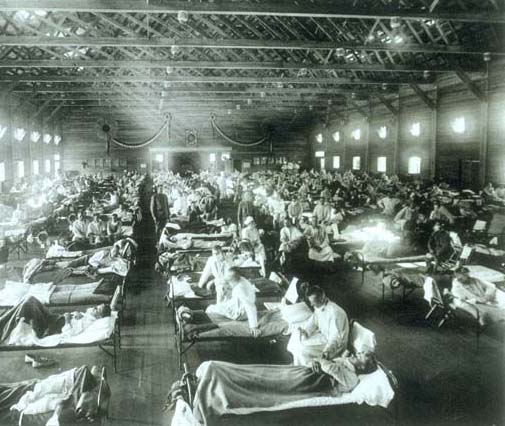
http://www.ideaexplore.net/news/041116/flu.jpg

Emergency hospital during 1918 influenza epidemic, Camp Funston, Kansas (source: National Museum of Health and Medicine, AFIP).

A bout of the flu can be mild. In young, healthy adults, many infections pass unnoticed. But sometimes the influenza virus evolves into a strain that decimates its victims. The worst known strain swept the world in the Fall of 1918, infecting 500-1000 million and killing 40-100 million, about 2-5% of people.

There are several theories about where the pandemic began, but the likeliest origin was in Haskell County, Kansas, in the United States. People in the sparsely populated county, where farmers raised pigs, poultry, cattle, and grain, began suffering from influenza in late January 1918. Unusually for flu, it was young, healthy adults who were hardest hit. Victims fell ill suddenly, many progressing to pneumonia and dying, often within days. Within weeks, however, the epidemic ended. The natural geographic isolation of this community normally might have contained the fatal flu in a sort of unintentional quarantine, but the First World War intervened. Men were uprooted from their home towns and congregated in huge numbers in army camps for training and then shipping out to other camps or to fight in Europe. The destination for men from Haskell County was Camp Funston, part of Fort Riley, Kansas, where the first influenza case was reported in early March. As soldiers moved among camps, the virus spread. Within two months, the epidemic spread to most of the army camps and most of the largest cities in the United States. As American soldiers went to France, so did the virus, spreading first from the port of Brest.

The flu then spread worldwide. The pandemic reached its height in the Fall of 1918. Spain was affected early, and because Spain was not fighting in the World War, there was no wartime censorship, and news of the outbreak became widely known, leading to the flu being called the Spanish Flu in many countries. In Spain, however, it was called French Flu or the Naples Soldier. In India, about 12 million people died of flu. In some US cities, people died so quickly that morticians couldn’t cope with the bodies. According to Jessie Lee Brown Foveaux, who worked in the Fort Riley laundry during the epidemic: “They were piling them up in a warehouse until they could get coffins for them.”

The disease started with cough, then headache. Temperature, breathing and heart rate increased rapidly. In the worst cases, pneumonia came next, the lungs filling with liquid, drowning the patients and turning them blue from lack of air. Patients bled from every orifice: mouths, noses, ears, eyes. Those who survived often suffered temporary or permanent brain damage. Several million developed encephalitis lethargica, in which victims were trapped in a permanent sleeplike and rigid state, as portrayed in the 1990 movie “Awakenings.” In others, normal thought processes were impaired. During negotiations to end World War I, US President Woodrow Wilson was struck with flu, and people around him noted that his mental abilities never fully recovered. The French leader George Clemenceau had wanted harsher punishment of Germany than Wilson had desired. Clemenceau may have convinced Wilson in his weakened state to accept such harsh terms, which may have been one of the factors causing World War II.

Since flu is highly contagious early in the illness, even before symptoms appear, strict quarantine may be necessary to stop its spread during an epidemic. Australia kept its 1918 flu death rate relatively low by enforcing quarantines. However, in many parts of the world, public health officials hesitated to impose such measures, giving the disease time to gain a foothold. In the US city of Philadelphia, a rally of half a million people was planned in September 1918 to sell bonds to fund the war, at just the time when the flu started to infect residents. Although doctors warned the public health director to cancel the rally, he wanted to meet the city’s quota to raise money for the war and refused to cancel the event. Within days after the rally, half a million city residents caught the flu.

Why was the 1918 flu so deadly? The influenza virus wasn’t preserved at the time of the outbreak, at least on purpose. But in the late 1990s researchers Ann Reid, Jeffery K. Taubenberger, and their colleagues extracted and sequenced the genetic material of the virus, RNA, from tissue of victims who died in the pandemic. They used bits of lung that were preserved in formalin from victims on army bases or from victims buried in permafrost in the Alaskan village of Brevig Mission, where flu killed 85% of adults. Comparisons with known flu viruses in humans, pigs, and birds suggest that some genes of the 1918 virus came from birds or an unknown animal source. Other scientists then were able to show that the amino acid sequence of hemagglutinin protein from the 1918 virus had several changes from other flu viruses that may have helped it to easily bind and invade human cells, and that made the virus look different enough from earlier flu virus strains that people had no immunity.

The possibility exists that another flu pandemic will sweep the world like the one in 1918. In 2004, an H5N1 influenza virus has killed millions of birds and at least 30 people in southeast Asia. So far this virus strain has not evolved the ability to pass directly from human to human, but that possibility becomes more likely as the bird flu pandemic continues and humans remain in contact with chickens, ducks, and other birds. The virus has killed two-thirds of people reported to be infected. Dr. Tim Uyeki, an epidemiologist for the US Centers for Disease Control, says, “you have the ingredients in Asia right now for a public health disaster.”

But since sequences of this bird flu virus are known, it may be possible to develop a vaccine or set of vaccines to protect against it. At a special meeting of influenza experts on November 11th and 12th, World Health Organization influenza program chief Klaus Stohr said, “It is not only possible, but also important, that influenza pandemic vaccines be made available… and there’s a shared responsibility needed to make that happen…. We have a huge window of opportunity now.”
Retrieved from “https://en.wikinews.org/w/index.php?title=The_Deadliest_Fall&oldid=2526338”
Comment (0)

Dale Ogden, 2010 California gubernatorial candidate, talks with Wikinews

">
Dale Ogden, 2010 California gubernatorial candidate, talks with Wikinews
Author: Admin Posted under: Uncategorized

Tuesday, April 27, 2010

Dale Ogden, a 2010 California gubernatorial candidate, talks with Wikinews reporter Mike Morales about his platform.

Ogden is a member of the United States’ Libertarian Party.

Retrieved from “https://en.wikinews.org/w/index.php?title=Dale_Ogden,_2010_California_gubernatorial_candidate,_talks_with_Wikinews&oldid=4629251”
Comment (0)

SpaceX scrubs Falcon I rocket launch

">
SpaceX scrubs Falcon I rocket launch
Author: Admin Posted under: Uncategorized

Monday, November 28, 2005

SpaceX called off the much-delayed inaugural launch of their new Falcon 1 rocket on Saturday from Kwajalein’s Omelek Island launch site. The intent was to launch the U.S. Air Force Academy’s FalconSat 2 satellite, which will monitor plasma interactions with the Earth’s upper atmosphere and magnetosphere.

The launch was delayed, then finally cancelled after an oxygen boil-off vent had accidentally been left open. The oxygen was unable to cool the helium pressurant, which then proceeded to evaporate faster than it could be replenished. A main computer issue, probably serious enough to cause a scrub on its own, was also discovered.

This long-anticipated flight was originally expected to be launched in January 2005, however a series of setbacks forced a series of delays, with the flight most recently scheduled to be in early 2006. It was intended to be launched from the Kwajalein atoll in the middle of the Pacific Ocean.

The maiden voyage was originally intended to launch from Vandenberg Air Force Base in California with a Naval Research Laboratory satellite and a Space Services Incorporated space burial payload.

Retrieved from “https://en.wikinews.org/w/index.php?title=SpaceX_scrubs_Falcon_I_rocket_launch&oldid=3172503”
Comment (0)